July 9th, 2026
Ever searched a weird rash or symptom online and ended up down a social media rabbit hole? You're definitely not alone. A new study published in the journal JAMA at the end of June found that social media has quietly become one of the biggest sources of health information for American adults — and it's reshaping how people make decisions about their own care.To make sense of what this means (and how AI fits into the picture), health information researchers spoke with Dr. Leana Wen, an emergency physician, clinical associate professor at George Washington University, and former Baltimore health commissioner.
The Numbers Are Bigger Than You'd ThinkThe study drew on a large, nationally representative survey backed by the National Cancer Institute, covering responses from thousands of adults meant to represent the broader U.S. population. A few standout findings:
- The vast majority of adults use social media regularly.
- Most of those users have shared health information — either general or personal — online.
- A large share have participated in online health communities.
- Most strikingly, roughly 1 in 5 social media users — around 47 million Americans — said they've actually made a health decision based on something they saw on social media.
Here's the twist: most of those same users admit they think a lot of the health content on social media is false or misleading. People also seem to know the water isn't entirely clean, but they're swimming in it anyway. Interestingly, older adults and Hispanic users were somewhat more likely to say they'd acted on health info they found online, and people managing chronic conditions like cancer, heart disease, or mental health issues were just as likely as anyone else to lean on social media for guidance.
Why Are So Many People Turning to Social Media for Health Info?It comes down to convenience and connection. Social platforms are free, always available, and often break down complicated medical topics into short, digestible videos. There's also something uniquely comforting about hearing from someone who's actually lived through the same diagnosis or treatment — that's a kind of reassurance a textbook just can't offer.There's a practical side too. Healthcare visits are often rushed, and people frequently leave the doctor's office with lingering questions. When it's hard to get a provider on the phone, social media becomes the next best (or at least fastest) option.
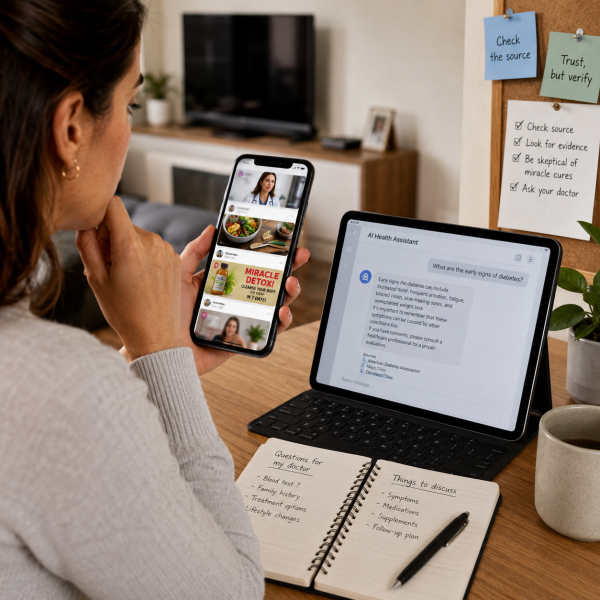
The Risks Are RealAccording to Dr. Wen, the biggest danger is that social media doesn't sort information by credibility. A board-certified physician, a research scientist, a patient sharing their personal story, and an untrained influencer selling a "miracle" product can all show up in the same feed — with nothing to signal which one actually knows what they're talking about.On top of that, social platforms are built to maximize engagement, which means dramatic or emotionally charged claims tend to spread faster than careful, nuanced science. Add in the possibility of undisclosed financial incentives (some creators, including certain medical professionals, get paid to promote supplements or products) and you've got a pretty murky information environment.There's also the echo chamber effect: once you engage with one type of health content, the algorithm tends to feed you more of the same. Over time, repeated exposure can make inaccurate claims start to feel true — which can even lead people to distrust solid, evidence-based advice from real medical professionals.
What About AI Chatbots?This is where things get especially relevant right now. AI isn't just shaping what gets recommended on social media — plenty of people are now asking chatbots health questions directly instead of using a search engine.Dr. Wen's take: AI can genuinely be a helpful educational tool. It's good at explaining medical terms in plain language, summarizing legitimate research, comparing treatment options at a general level, and helping you prepare smarter questions for your next doctor's visit.But — and this is important — AI can also sound completely confident while being wrong. It doesn't fully understand the nuances of your personal medical history, and it's not yet reliable enough to replace an actual clinician's judgment. The advice here is simple: treat AI-generated health info with the same healthy skepticism you'd apply to a random post on social media, and always double-check with a real doctor.
Is Any of This Actually Useful?Yes, absolutely — social media isn't all bad news. Plenty of physicians, nurses, scientists, hospitals, and public health organizations use these platforms to share accurate, evidence-based information quickly. For people living with chronic or rare conditions, social media can be a genuine lifeline — a place to swap practical tips, find support groups, and feel less alone in a hard diagnosis.
How to Actually Evaluate What You're SeeingDr. Wen offered a simple framework:
- Check the source. Is this coming from a physician, scientist, academic medical center, government health agency, or a recognized patient advocacy group? Even reputable people can share opinions rather than evidence, so ask whether real research backs up the claim.
- Be wary of "miracle" fixes. If someone's pushing a supplement, gadget, or treatment that sounds too good to be true, it probably is. Be extra cautious of anyone who speaks in absolutes — medicine is rarely that black and white.
- Cross-check before acting. Look for agreement among multiple trusted organizations — think the World Health Organization, American Medical Association, or Cleveland Clinic. And if the information might lead you to start or stop a medication, or spend money on something, loop in your actual healthcare provider first.
The Bottom LineSocial media and AI aren't going anywhere, and honestly, they've made medical knowledge more accessible than ever. The key is using them for what they're good at — understanding concepts, learning from others' experiences, and prepping for smarter conversations with your doctor — while leaving the actual diagnosis and treatment decisions to qualified professionals who know your specific situation.
This piece is for general informational purposes. If you have concerns about a personal health issue, it's best to check with a healthcare provider directly.
